
Capital Exchange CEO Skip Oceanlane: Reviving Finance in SL
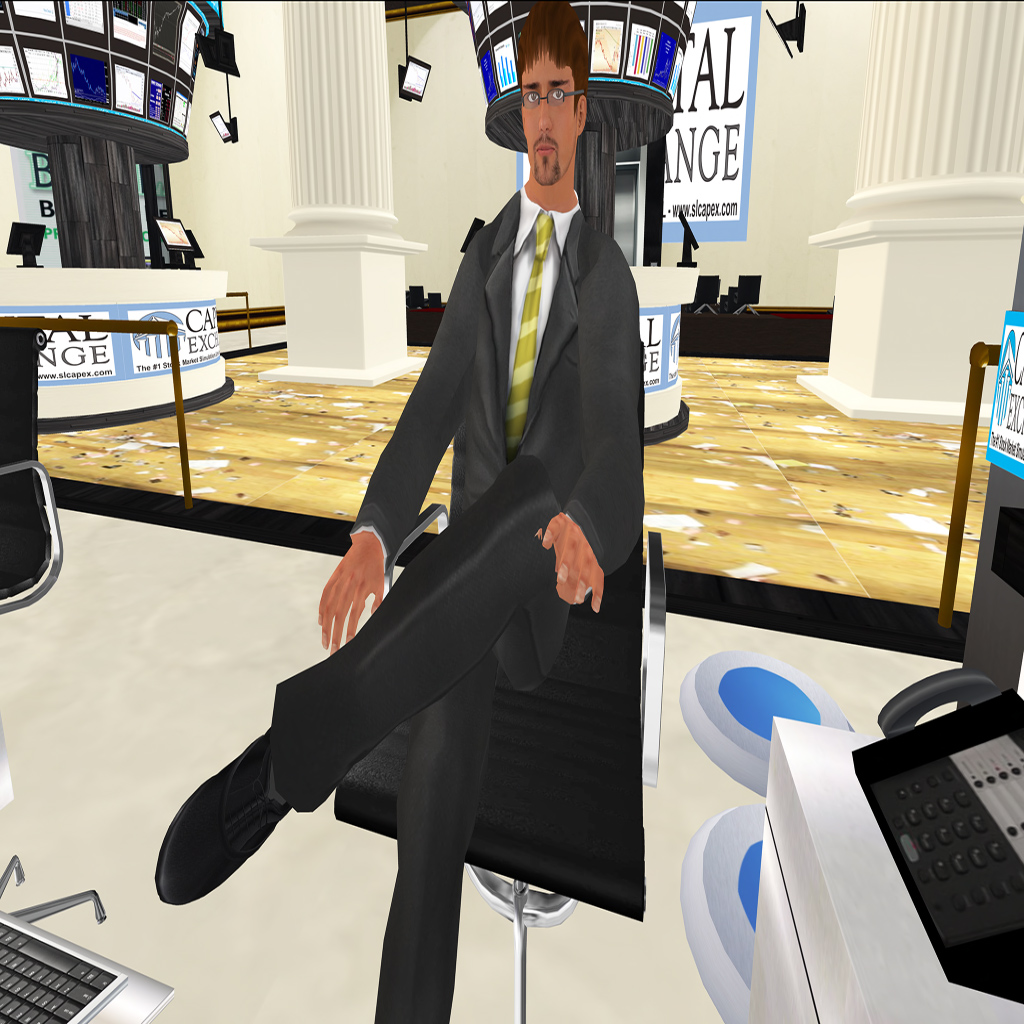
CEO of Capital Exchange Skip Oceanlane sat down with SL Business Review. (Photo by Sachiko Cheng).
In 2008, a crisis struck the banking system that caused ripples around the world, toppling banks and nearly economies.
As Lehman Brothers and Bear Stearns teetered, the virtual economy of SL faced an economic collapse of its own. At the time, SL banks were largely unregulated. This left room for many banks to operate unethically, to say the least.
“With no regulation,” said Skip Oceanlane, CEO of the Capital Exchange (CAPEX), in an interview with SL Business Review. “It was a terrible time.”
That year, scandal marred the banking and finance sector of the virtual economy when Ginko Financial allegedly bilked investors of a USD equivalent of $750,000. Promising returns as high as 40%, the bank accepted loans then told investors it would no longer operate.
Linden Labs (R), wielding more power than any federal regulatory agency, outright banned the any practice of “[offering] interest or any direct return on an investment.” Virtual banks had to operate under the same rules as RL banks.
The policy change changed the landscape of the virtual economy. Many banks–nearly all–folded. Investors lost money. Entire stock exchanges collapsed. But the CAPEX, (formerly known as the SL Capital Exchange), has managed to wether the economic tsunami that followed the Banking Ban of 2008.
At the time, Oceanlane owned his own financial institution, Crystal Springs Bank. But the bank always paid back investors within 24 hours, he said. After the ban, he refocused his business as Crystal Springs Land and Loan, but closed it in 2009 and took a one year hiatus from SL.
When he returned, he recognized an opportunity to revive the CAPEX, known at that time as SL Capital Exchange. In 2011, he bought the exchange from then CEO, Scott Nestler, and dropped the “SL.” With the purchase, Oceanlane tried to usher in an era of “honest and integrity,” he said.
“I instituted rules,” he said. “And I enforced them.”
The CAPEX now has an 11 member Capital Exchange Regulatory Commission (CERC), which advises on major policy decisions and votes on IPO candidates. And the CEO even abides by self-imposed rule.
“My involvement in buying and selling stock is tremendously restricted,” he said. “As exchange owner, and owner of the software, I can see all the trading, so I have an unfair advantage.”
Even in the personalized stock classes he offers, he doesn’t offer advice about specific stocks to buy. And the 45 year-old New Yorker offers RL information to anyone who asks.
With 60 companies publicly traded on the Exchange, it already has three IPO applications for July and August, a process he takes very seriously.
“Since I took over, only a couple of companies have outright failed here,” said Oceanlane. “The vast majority are active, following the rules, and playing the game. Before I took over, it was the opposite – most companies disappeared, and only a small handful would stay around.”
And to top it off, the candid Oceanlane recently celebrated his 18 month anniversary as the CEO of CAPEX.
While it would be cliche to write that the CAPEX stock remains high, it would be accurate, staying above $8L per share for at least a month.
“Capital Exchange is a great place for anyone to make a linden profit,” he said.
For more, vist slcapex.com or visit the in-world trading floor.
Comments
2 Responses to “Capital Exchange CEO Skip Oceanlane: Reviving Finance in SL”Trackbacks
Check out what others are saying...-
[…] introduced the virtual stock exchange in CAPEX 101 and introduced to the man who runs it. Now it’s time to figure out some strategies for choosing […]






 inKLine Media

Too bad capex wasn’t run by a morally stable, incorruptible person, instead it’s run by skip.
If capex was the NYSE skip would already be in jail.
His favoritism towards one company in particular is extremely suspicious.