
Second Life’s Teaching Impediment
By Bill Kaye
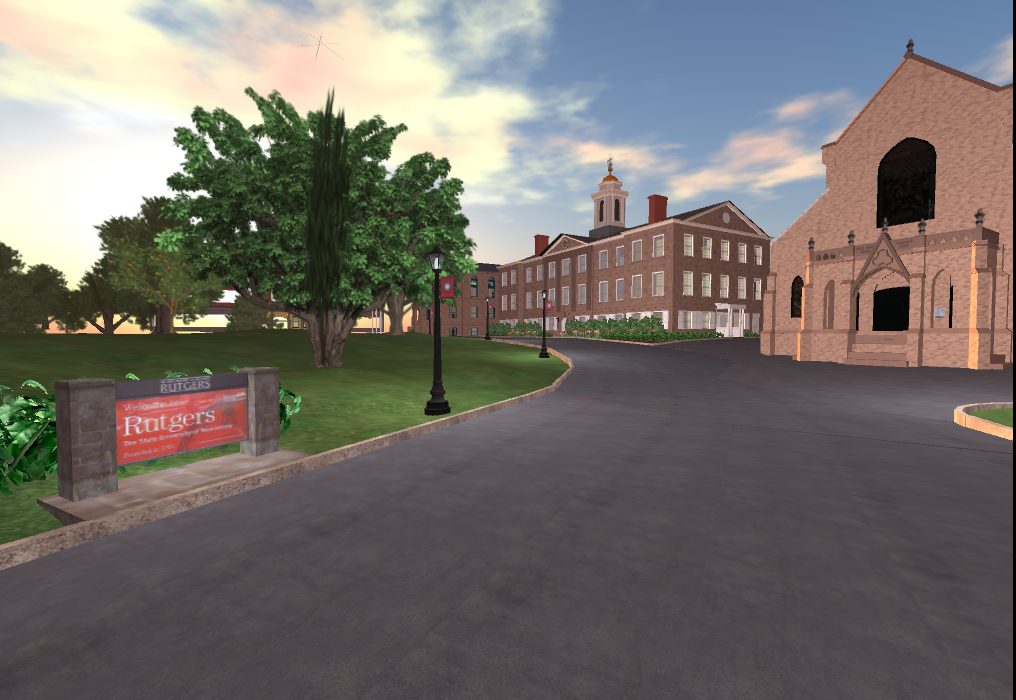
Rutgers University campus in SL. (Photo by Bill Kaye)
For educators who recognize the rising popularity of online colleges in real life, Second Life seemed like a fitting expansion to that trend. SL allowed students from all over the world to converge in one place to not only share ideas, but defy the physical limitations of real life.
Many colleges set up a presence in Second Life, using them for marketing, educational and communication purposes. Some offered virtual tours. To encourage the use of SL for academic purposes, Linden Labs offered a discount to educational institutions.
Business had slowed since 2008. In 2010, LL eliminated the discount for educational institutions, though it rebuked any notion that the decision had to do with economics.
“Schools had to drop because they could not get their budget increased to cover twice the cost,” said Thynka Little, the in-world personification of LuAnn Philips, in an interview with SL Business Review.
As the Virtual Worlds Coordinator for Cooperative eXtension, Little (aka Philips) works to facilitate teaching and learning techniques for “land grant” universities that maintain a presence in SL. (Land grant universities receive funding–which is designated for agricultural, mechanical and other scientific research–from the United States federal government.).
Through Cooperative eXtension, any contributing institution or educator can use land for research, market their respective institutions and experiments and gain access to training tools and activities. Little recently coordinated the Virtual State Fair, which served as a marketing device for the project and its contributing instituions.
“These regions function as marketing to the SL audience, teaching space for educators, and professional development about immersive learning for our staff,” said Little.
After LL eliminated the tier discount for educators in 2010, the initial burst of outrage reached publications such as the Chronicle of Higher Education. Many educators threatened to withdraw their presence from SL in protest, unable to justify the costs. Already perturbed by the impending increase in tier fees, many academics also criticized SL for its clunkiness, lack of technical/customer assistance and the prevalence of non-academic activities that serve as distractions.
Despite suggestions that educators fled SL in waves, many still retain a presence in SL. Hypergrid Business reported in 2011 that nearly a quarter of educators planned to simply reduce the amount of land they owned, but universities did not entirely abandon SL, or more importantly, from technology itself.
The story in Hypergrid, written by Joe Essid, pointed out an important factor: many educators had started to transition to other virtual worlds, in particular, OpenSim. The author also noted that some educators took advantage of the stipulation that they can retain the discount if they paid far in advance. By doing so, universities could continue existing projects.
While OpenSim may be growing more attractive to educators, she believes that SL attracts more of a mainstream audience than OpenSim and has the ability to attract a larger consumer base. In other words, she believes, in all likelihood, that they’ll have to first wander SL before they learn of OpenSim.
“It is hard enough to get people to come to Second Life never mind our individual region in Open Sim,” said Little.

Thynka Little (Photo from thyknalittle.com).
While Cooperative eXtension continues to rebuild content in OpenSim to reflect its SL content, Little said that the organization plans to stay in SL until 2014.
“SL remains the only feasible location,” said Little. “After that, we will see how Open Sim develops.”
So while it’s unfair to say that educators have already abandoned SL, it’s also unfair to say that it could never happen.
Editor’s Note:
Check out Cooperative eXtension’s “Winter Safety Game” by clicking the SLURL here.






 inKLine Media